
Why Choose Chitin and Chitosan Biomaterials?
Chitin and chitosan biomaterials are renewable polymers that combine useful chemical properties with a wide range of potential applications. Their combination of biodegradability, biocompatibility and chemical versatility makes them attractive for applications ranging from packaging and water treatment to biomedical materials.
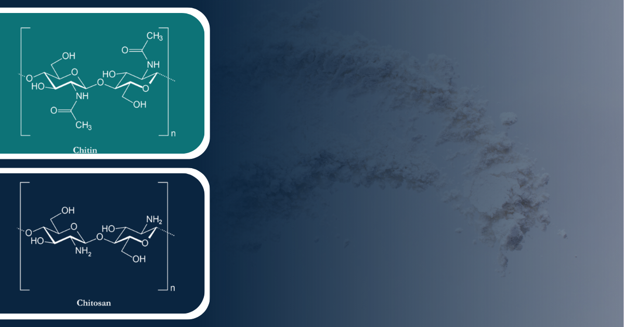
Shrimp, crab, and lobster shells are common byproducts of seafood processing. Yet these shells contain chitin, the second most abundant natural polymer after cellulose [1]. Once extracted from these shells, chitin can be converted into chitosan, turning a common seafood byproduct stream into a higher-value source of biomaterial.
Why Chitin and Chitosan Stand Out?
Chitin is a natural polysaccharide found in crustacean shells, fungal cell walls and other biological structures. Chitosan is produced by partially removing acetyl groups from chitin, a process known as deacetylation. That chemical change matters. It exposes amino groups along the polymer chain, giving chitosan a positive charge in acidic conditions. These groups allow chitosan to interact with negatively charged surfaces and bind certain metal ions [2,3].
For manufacturers, this chemistry opens several processing routes. Chitosan can be prepared as films, fibers, gels, beads, coatings and nanoparticles, while its reactive amino and hydroxyl groups can be modified to achieve specific properties for different applications [2]. Chitin, although less soluble and therefore harder to process, offers high structural stability and can also be engineered into fibers and nanoscale materials [4].
One practical point is that “chitosan” is not a single, fixed material. Molecular weight and degree of deacetylation influence solubility, viscosity, charge density and biological performance [2,5]. For product developers, specification therefore matters as much as the polymer name. A consistent, traceable feedstock can help manufacturers control formulation behavior and choose grades suited to coatings, membranes, composites or biomedical uses.
Chitosan Properties and Functional Benefits
Conventional polymers are often chosen for their mechanical performance, low cost, or easy processing. Additives and surface treatments are then used to give them additional properties, such as antimicrobial activity or biocompatibility. Chitosan brings several useful characteristics from the outset. Unlike many conventional polymers, it can offer functional properties in addition to its role as a structural material. Research has established that chitosan is biodegradable and biocompatible. Its antimicrobial activity has also been widely reported, although its effectiveness depends on factors such as molecular weight, degree of deacetylation, pH, and the type of microorganism involved [6].
That makes chitosan especially interesting for applications where the material must do more than provide shape. Chitosan has been studied across wound care and drug delivery [5], food and agricultural applications [6], and even water treatment [7].
Chitosan is not a universal replacement for petrochemical plastics. Moisture sensitivity, variable raw material quality and processing limitations still need to be managed. But chitosan can replace petrochemical plastics in many applications, with the main advantage being that chitosan is a biopolymer whose properties can be modified for different applications, with sustainability considered from the beginning [2].
Chitin from Seafood Byproducts
The sustainability benefits become even stronger when chitin is recovered from seafood byproducts [7]. At Atlantic BioCorp, we apply this circular approach by sourcing shrimp shell byproducts from the Atlantic Canada fisheries, and then transforming this biomass into chitin, chitosan and derivatives through our proprietary MCE process. This proprietary process combines mechanical preparation, a citric-acid chemical stage and organic enzymes rather than conventional hydrochloric acid and sodium hydroxide, enabling cleaner, high-purity and consistent biomaterial output.
Conclusion
What makes chitin and chitosan stand out is more than just their natural origin. Their versatile chemistry and range of applications make them promising materials for manufacturers looking for both performance and sustainability. For those looking to reduce dependence on fossil-derived feedstocks while adding useful biological and chemical functionality, that combination deserves serious attention.
Wondering if chitin- or chitosan-based biomaterials fit your project needs?
References
[1] Seangarun C, Seesanong S, Boonchom B, et al. (2025). Extraction of Chitin, Chitosan, and Calcium Acetate from Mussel Shells for Sustainable Waste Management. Int. J. Mol. Sci., 26(15): 7107.
[2] Zargar V, Asghari M, Dashti A (2015). A Review on Chitin and Chitosan Polymers: Structure, Chemistry, Solubility, Derivatives, and Applications. ChemBioEng Rev., 2(3): 204–226.
[3] Victor RS, Santos, SMC, B. Sousa, BV, et al. (2020). A Review on Chitosan’s Uses as Biomaterial: Tissue Engineering, Drug Delivery Systems and Cancer Treatment. Materials, 13(21): 4995.
[4] Pillai CKS, Paul W, Sharma CP (2009). Chitin and chitosan polymers: Chemistry, solubility and fiber formation. Prog. Polym. Sci., 34(7): 641–678.
[5] Mu L, Wu L, Wu S, Ye Q, Zhong Z (2024). Progress in chitin/chitosan and their derivatives for biomedical applications: Where we stand. Carbohydr. Polym., 343: 122233.
[6] Rajoka MSR, Mehwish HM, Wu Y, et al. (2020). Chitin/chitosan derivatives and their interactions with microorganisms: a comprehensive review and future perspectives. Crit. Rev. Biotechnol., 40(3): 365–379.
[7] Junceda-Mena I, García-Junceda E, Revuelta J (2023). From the problem to the solution: Chitosan valorization cycle. Carbohydr. Polym., 309: 120674.