
Responsible sourcing of nitrogen-rich raw materials: what are our options?
Nitrogen-rich biopolymers are in growing demand across agriculture, materials science and water treatment. Here we look at why shellfish-derived chitin and chitosan are such efficient natural nitrogen sources and why producing them from shrimp shell byproducts is one of the most responsible sourcing options available today.
Every functional material starts with a sourcing decision. As industries move away from petrochemical inputs, the question is no longer only what a raw material can do, but where it comes from and at what cost?
Where high nitrogen content is an advantage
Few natural polymers carry nitrogen in their structure, and that scarcity makes nitrogen-rich biomaterials valuable across many industries. Here are a few examples:
Agriculture
Chitosan acts as a plant-available nutrient source and as a carrier for slow-release fertilizers, which is of high value in agriculture because it works by improving nitrogen-use efficiency and reducing losses to the environment [1].
Firefighting
The nitrogen content of chitosan can also be useful in low-impact flame retardants, especially since during combustion it releases non-flammable gases and promotes the formation of a protective char layer [2].
Advanced materials
In advanced materials, chitin and chitosan are preferred precursors for nitrogen-doped carbons used in wastewater remediation and supercapacitor electrodes, precisely because the nitrogen is already built into the molecule [3].
The high nitrogen content of chitin and chitosan
Chitin is a nature's powerhouse polymer derived from crustacean shells, holding the crown as the second most abundant biopolymer on Earth (after cellulose) [4].
Unlike conventional biopolymers like cellulose or starch, this high-performance material packs a nitrogen punch in every single repeating unit. Chitin boasts roughly 7% nitrogen by weight, while its premium, fully deacetylated derivative chitosan reaches an impressive theoretical 8.7% [2]. Real-world elemental analyses confirm chitosan delivers 5.8–7.6% nitrogen alongside pure carbon and oxygen, making it both a high-potency nutrient reservoir and a high-value functional polymer [1]. Best of all, you don't have to look far for supply: standard shrimp shells deliver 20–30% chitin, making them one of the richest, most accessible, and highly scalable bio-sources on the market [5].
Responsible sourcing: biomaterials from fishery byproducts
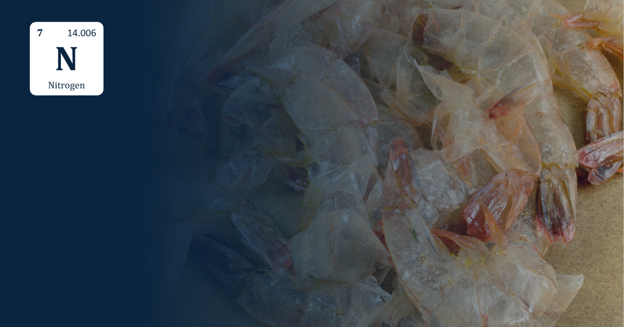
Shrimp processing discards up to 60% of the harvest as shells, heads, and tails [6], generating an astounding 6–8 million tonnes of shell waste globally every year—much of it dumped in landfills or ocean waters, driving up disposal costs and threatening coastal ecosystems [5, 7]. What most see as environmental liability, we at Atlantic BioCorp see as an untapped goldmine of bioactive nitrogen.
We use seafood processing byproducts from Newfoundland (Canada) to manufacture high-purity chitin and chitosan biomaterials. No animals harvested, no farmland required. Instead, we intercept this concentrated waste stream and upgrade it through state-of-the-art, proprietary process that combines mechanical preparation, a citric-acid chemical stage and organic enzymes. By implementing this process rather than the conventional hydrochloric acid and sodium hydroxide, we enable the production of more sustainable, high-purity and consistent biomaterial output. And by partnering with regional processors, we ensure minimal transport miles, supply-chain traceability, and true circular economy manufacturing [7].
For forward-thinking formulators demanding nitrogen-rich functionality, the ultimate solution is here: traceable, renewable biomaterials intelligently recovered from existing food production byproducts.
Learn more about our chitin- and chitosan-based biomaterials.
Wondering if our biomaterials fit your project specifications?
References
[1] Riseh RS, Vazvani MG, Kennedy JF (2023). The application of chitosan as a carrier for fertilizer: A review. International Journal of Biological Macromolecules, 252: 126483.
[2] Hu Y, Ye Y, Wang J, et al. (2025). Functionalization of chitosan and its application in flame retardants: A review. International Journal of Biological Macromolecules, 295: 139615.
[3] Foong SY, Liew RK, Yek PNY, et al. (2024). A review in production of nitrogen-enriched carbon materials via chitin pyrolysis and activation for enhanced wastewater remediation. Current Opinion in Green and Sustainable Chemistry, 247: 100920.
[4] Teixeira-Costa BE, Andrade CT (2021). Chitosan as a Valuable Biomolecule from Seafood Industry Waste in the Design of Green Food Packaging. Biomolecules, 11: 1599.
[5] Haider MM, Jian G, Li H (2022). Impact of chitin nanofibers and nanocrystals from waste shrimp shells on mechanical properties, setting time, and late-age hydration of mortar. Scientific Reports, 12: 20539.
[6] Çelebi M, Tav A, Kaya MA, Özdemir OZ (2025). Scalable Production of Low-Molecular-Weight Chitosan: Comparative Study of Conventional, Microwave, and Autoclave-Assisted Methods. Polymers (Basel), 18(2): 213.
[7] Mathew GM, Puthiyamadam A, Sasikumar K, et al. (2021). Biological treatment of prawn shell wastes for valorization and waste management. Bioresource Technology Reports, Bioresource Technology Reports, 15: 100788.